TRUSS VAULT
TRUSS Liq. Pool
The TRUSS Liq. Pool is the TRUSSV/WETH pool on Uniswap v3, with a 1% fee. It is the normal place to buy and sell TRUSSV, and anyone can provide liquidity to it.
What it is
- A standard Uniswap v3 pool: 0xd80D1C3e8dFD84AAab769B45f2BaE09448Fabc42. It can also be used from any Uniswap interface.
- Every trade pays a 1% fee, which goes to the liquidity providers in the pool.
- The pool is separate from the TRUSS VAULT contract. It is traded constantly to remove arbitrage opportunities; its price is still set by trading and can be above or below the TRUSS VAULT’s NAV.
- The pool is small, so large trades move the price. Always check the amount you will receive before you sign.
Buying and selling TRUSSV
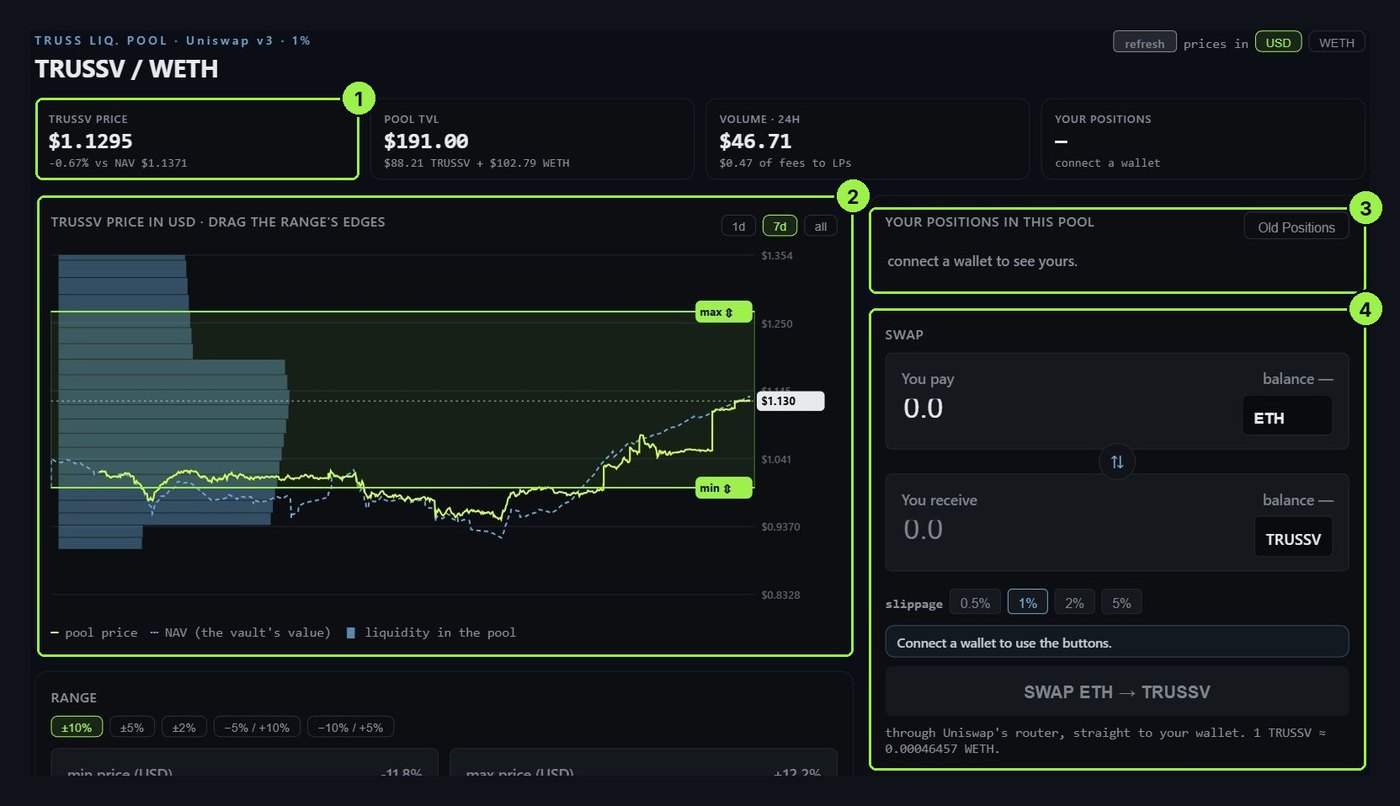
- 1The TRUSSV price in the pool and its difference from NAV.
- 2The pool price (solid line) against NAV (dashed), and the liquidity in the pool.
- 3Your liquidity positions in the pool.
- 4The swap box: pay ETH to receive TRUSSV, or press ⇅ to sell TRUSSV for ETH.
- Connect your wallet and open the TRUSS Liq. Pool tab.
- Enter the amount to pay and check the amount you will receive.
- Choose your slippage limit. If the price moves past it before your transaction lands, nothing happens.
- Sign the swap. It goes through Uniswap’s router, and the tokens go straight to your wallet.
Below NAV, buying in the pool gets more backing per dollar; above NAV, it gets less. The chart shows both lines.
Providing liquidity
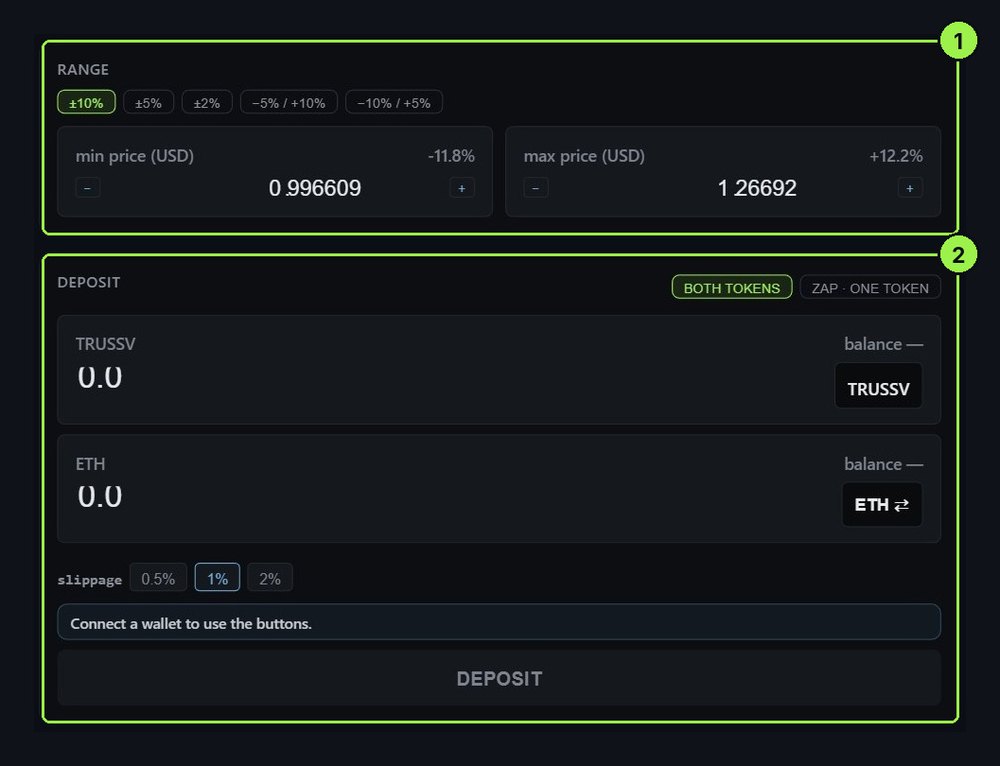
- 1Choose a price range: a preset, the min and max boxes, or drag the range edges on the chart.
- 2Deposit both tokens, or zap in with one token and let the page swap part of it.
- Your position is a Uniswap v3 position NFT held in your own wallet.
- It earns a share of the 1% trading fee only while the pool price is inside your range.
- On the same tab you can add to, remove from and collect fees on your positions. Emptied positions move to Old Positions.
- The position is not staked in any gauge and earns no emissions.
Risks
- Loss to price movement. As the price moves, your position sells the rising token and buys the falling one, so it can end up worth less than simply holding.
- Out of range. Outside your range the position earns nothing and holds only one of the two tokens.
- Thin liquidity. A small pool can move sharply on a single trade, and fee income is not guaranteed.
- TRUSSV itself. Its value depends on the TRUSS VAULT; see TRUSS VAULT and TRUSSV and Risks.