TRUSS VAULT
TRUSS VAULT and TRUSSV
The TRUSS VAULT is a protocol-managed vault that runs the same bots across several Aero pools. TRUSSV is a share of everything it holds. Most holders buy and sell TRUSSV in its Uniswap pool; it can also be minted or redeemed at NAV for a high fee, or earned through a TRUSS share vault.
What it is
A personal vault holds one depositor’s money in one pool. The TRUSS VAULT pools everyone’s money and spreads it across several Aero pools, each run by the same bots, through the same vault executor and with the same Manager fee as a personal vault. Its token, TRUSSV, is your share of everything it holds.
- Who can use it. Any wallet: minting, redeeming, the TRUSS Liq. Pool and TRUSS share vaults are open to everyone.
- One contract. The TRUSS VAULT and the TRUSSV token are the same contract (0xd0BebB147Dc91bb0d155195634F3D980a2F66e04). TRUSSV is a standard token with 18 decimals that you can hold and send like any other.
- Its positions are vaults it owns. Each position is a TRUSS LP vault on one Aero pool, owned by the TRUSS VAULT contract instead of a person.
- Everything is public. The TRUSS VAULT tab shows the NAV, its history and every position the vault holds, and each position opens its own public P&L page.
Using TRUSSV
For most people, holding TRUSSV is a two-step process:
- Buy TRUSSV in the TRUSSV/WETH pool on the TRUSS Liq. Pool tab. You pay the pool’s 1% trading fee plus any price impact. See TRUSS Liq. Pool.
- Sell it back to the same pool when you want to cash out, again paying the 1% pool fee.
In between, follow its value on the TRUSS VAULTtab: the NAV (the value of one TRUSSV in the vault’s own accounting), the pool price, both over time, and every position the vault holds, each with its own public P&L page. With your wallet connected, YOUR TRUSSV shows how much you hold.
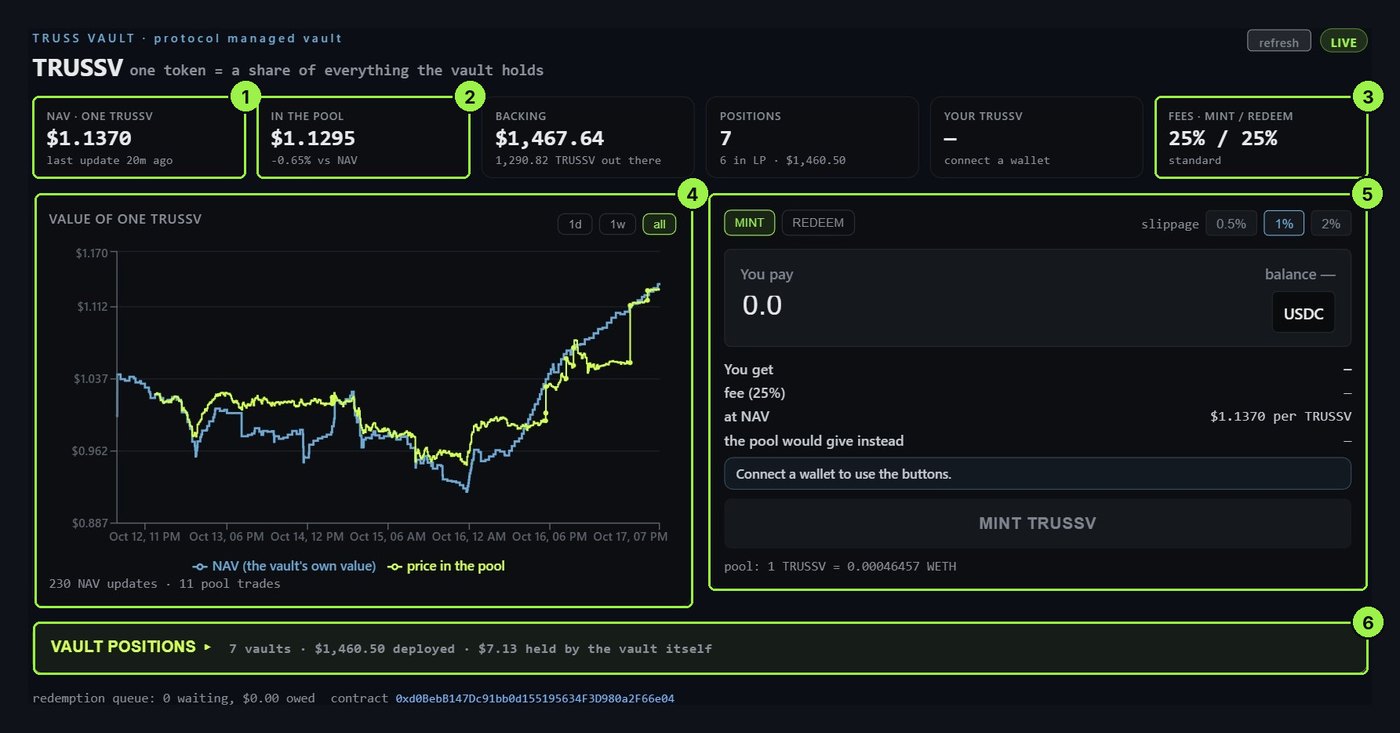
- 1NAV: the value of one TRUSSV.
- 2The price in the pool, and how far it is from NAV.
- 3The current mint and redeem fees.
- 4NAV and the pool price over time.
- 5Mint and redeem at NAV, less the fee.
- 6The vault’s positions, each with its own public P&L page.
Minting and redeeming at NAV carry a large fee (currently 25% each way, and never more than 30%). Trading in the pool costs only the pool’s 1% fee plus price impact, so the pool is the normal route in and out. Minting can make sense only when the pool price is far above NAV, and redeeming when the pool is too small to take your trade.
How NAV works
NAV is the value of one TRUSSV: everything the vault holds, less what it owes, divided by the TRUSSV in circulation.
| Counted | How |
|---|---|
| Tokens the vault holds | Every listed token held by the TRUSS VAULT contract, at its 5-minute average price. |
| Each position | The position’s two tokens, worked out at the vault’s own 5-minute prices - never the pool’s current price, so pushing a pool around cannot inflate NAV - plus uncollected fees and the position vault’s idle tokens. |
| AERO owed | The AERO each position’s gauge owes, less the Manager fee that will be taken from it. |
| Less: owed to redemptions | USDC owed to queued redemptions is a debt and is taken off. |
| TRUSSV in circulation | All TRUSSV, except what the TRUSS VAULT holds itself or inside its positions - that TRUSSV is never counted on either side. |
Prices
Every price comes from pools’ own on-chain history - no outside price feeds. Each token is priced through one pool to USDC (counted as $1) or to another priced token, up to four pools deep. NAV uses each pool’s 5-minute average, and nothing traded in the current block counts, so a flash loan or a sandwich cannot move it. A pool with no trade for 30 minutes (by default) gives no price at all.
The safety gate
For every token the vault holds $100 or more of, prices must be calm: by default the last minute’s average must be within 0.5% of the 5-minute average, and the current price within 1%. If any such token fails, or any token held has no price, that NAV is not used: a mint or redemption reverts with nothing moved, and you can try again a little later.
How often it updates
- Every mint and redemption works NAV out fresh, in the same transaction.
- The protocol also stores NAV on chain at least once an hour, and sooner when it moves by more than about 0.5% (at most every 5 minutes).
- TRUSSV paid to share vaults uses the last stored NAV that passed the gate, no more than 2 hours old by default.
Minting with USDC
On the TRUSS VAULT tab, pay in USDC and receive TRUSSV at NAV, less the mint fee. You set the least TRUSSV you will accept; if NAV moves past it before your transaction lands, nothing happens.
- A mint is refused while the vault is paused, while the safety gate fails, or while a position is stuck (see below).
- The owner wallet can set an hourly cap on minting. There is none by default.
Redeeming for USDC
Redeem TRUSSV on the TRUSS VAULT tab for its USDC value at NAV, less the redeem fee. The TRUSSV is burned straight away.
- Paid now - whatever the vault’s free USDC covers (USDC beyond what queued redemptions are owed) is sent to you in the same transaction.
- Queued - the rest becomes a claim fixed in USDC at that NAV, paid first in, first out. A queued part must be at least $1. If others are already queued, your whole redemption joins the back of the queue.
- Anyone can pay the queue, and the protocol’s keeper pays it as soon as free USDC arrives. If a payment to you can’t be sent, it is credited to you to collect later, so one blocked address can never hold up the queue.
- USDC owed to the queue is a debt: it is taken out of NAV, and nobody - not even the owner wallet - can move it.
- If the oldest claim waits more than 7 days, anyone can shut the TRUSS VAULT down (see below).
The contract also has an instant-only exit that pays in full straight away or fails, for when you would rather not queue.
Fees
| Action | Fee | Where it goes |
|---|---|---|
| Mint | Set by the owner wallet, shown before you sign. Started at 25%; never above 30%. | Half (by default) to the protocol’s fee wallet, the rest kept as backing for every holder. |
| Redeem | Set by the owner wallet, shown before you sign. Started at 25%; never above 30%. | Paid in full now: half (by default) to the fee wallet, the rest kept as backing. If any part is queued: all of it kept as backing. |
| TRUSSV from a share vault | None | - |
| Trades in the TRUSSV/WETH pool | 1% pool fee | The pool’s liquidity providers. |
The TRUSS VAULT owner wallet and wallets it marks fee-free pay no mint or redeem fee. The owner wallet can set a different fee for one wallet, never above 30%. The positions themselves pay the same 10% Manager fee (emissions) and 0.01% Manager fee (rebalances) as any vault; see Fees.
The TRUSSV/WETH pool
TRUSSV also trades in a Uniswap v3 TRUSSV/WETH pool with a 1% fee (0xd80D1C3e8dFD84AAab769B45f2BaE09448Fabc42). Because minting and redeeming at NAV carry a high fee, the pool is the normal way to buy and sell, and its price can sit above or below NAV.
- Buy or sell on the TRUSS Liq. Pool tab, or through any Uniswap interface.
- On the same tab you can add TRUSSV/WETH liquidity in a range you choose (or zap in with one token), add to or remove your positions, and collect their fees.
- Compare the pool price with NAV before you trade: below NAV, buying in the pool gets more backing per dollar; above it, minting may be cheaper even after the fee.
- The pool is separate from the TRUSS VAULT contract. The vault reads its price to price the TRUSSV paid to share vaults, and before the vault adds liquidity to a TRUSSV pool, that pool’s price must be within 1% (by default) of a freshly worked-out NAV.
TRUSS share vaults
A TRUSS share vault is a personal vault - your own contract, owned by your wallet, run by the same bots - that pays part of its AERO to you as TRUSSV. On every claim, the gross AERO is split:
| Share | What it is |
|---|---|
| 60% | Stays in your vault as AERO, which the bot sells or reinvests. |
| 30% | Goes to the TRUSS VAULT, which mints TRUSSV straight to your wallet in the same transaction, with no fee. |
| 10% | The Manager fee (emissions). |
- How the TRUSSV is priced. AERO is valued at the lower of its price at the last NAV and its live price, and TRUSSV at the higher of NAV and the TRUSSV/WETH pool’s 5-minute average. With this default pricing you never get more TRUSSV than NAV allows; the owner wallet can switch the pricing to NAV alone or to the pool price alone.
- If it can’t mint right then (paused, or no recent NAV that passed the gate), the amount is recorded as owed to you and paid from your vault’s AERO on a later claim. The bot’s work is never held up by it.
- Locked at creation. The split is fixed in your vault when it is created and shown before you sign; the fee plus the TRUSSV share can never exceed 50%.
- Only you can trade TRUSSV in your share vault; the bot never can.
Limits
| Limit | Rule |
|---|---|
| Positions and tokens | At most 30 position vaults and 32 tokens, so a mint or redemption, which values all of them, always fits in one transaction. |
| Where money can go | Between the TRUSS VAULT and its own position vaults; to approved routers during a swap; to the fee wallet (its share of mint and redeem fees); to holders through redemptions and the share-out; to the owner wallet through a delayed rescue of tokens that are not listed, and, during the launch phase only, through withdraw-everything (see below). |
| Each swap | Only through an approved router, between listed tokens, and at no more than 1% below the previous-block pool price by default (never more than 5%). |
| Swaps per day | All swap losses in a day together at most 0.5% of the backing by default (never more than 2%). This applies to the owner wallet too. |
| USDC buffer | A day-to-day manager named by the owner wallet cannot move free USDC below 10% of the backing (by default). The owner wallet itself can. |
| TRUSSV trades by the vault | Only by the owner wallet, and only at NAV or better. |
| Hourly caps | None by default. A redemption cap, if set, can never be below $1,000 an hour. |
Pause, shutdown and the backstops
Pause
The owner wallet, or a keeper it names, can pause minting, redeeming and share-vault TRUSSV. A pause ends by itself after 7 days, and a new one can’t start until a day after the last one ended. Paying the queue, a shutdown and the share-out can never be paused.
Shutdown
The owner wallet can shut the TRUSS VAULT down at any time. Anyone can, once any of these is true:
- 14 days (by default) have passed with no NAV update from the protocol and no check-in.
- 14 days (by default) have passed with no NAV that passed the safety gate.
- The oldest queued redemption has waited more than 7 days.
After a shutdown:
- Free USDC pays the queue first.
- Anyone can close the positions and bring every token home to the TRUSS VAULT.
- The share-out opens once every position is empty and nothing is stuck - or 7 days after the shutdown, whatever happens, so one broken token can’t hold everyone’s money.
- Each holder burns TRUSSV for their share of every token the vault holds, paid in the tokens themselves.
- An unpaid queued claim turns back into TRUSSV and shares in the same way. Its fee is not refunded.
A stuck position
If a position comes home with money in it that can’t be taken out (a token that won’t move), NAV can’t pass, so minting, redeeming and share-vault TRUSSV stop until it is emptied. The owner wallet can write it off with a delayed change: redeeming then works again, but minting and share-vault TRUSSV only once the position has been emptied, so nobody buys in below what it may be worth.
Owner powers during the launch phase
The TRUSS VAULT is in its launch phase until the owner wallet (0xA1c7b04487489b6Ab19Ab44b35108B9a1786C884) ends it - a one-way switch. Until then the owner has extra powers, listed here plainly.
- Withdraw everything. While all TRUSSV outside the owner wallet and the vault itself - including queued redemptions - adds up to no more than 5% of the starting TRUSSV, the owner wallet can withdraw every token the TRUSS VAULT holds, after bringing its positions home. It can never take TRUSSV, or the USDC owed to queued redemptions, and never after a shutdown. It is measured on what others hold, so the owner minting more TRUSSV can never unlock it.
- No waiting period. Changes that normally wait out a delay - listing a token, approving a router or factory, replacing the valuing contract, rescuing an unlisted token, writing off a stuck position - can take effect at once while the delay is zero, as it may be during the launch phase.
- Ending it. Ending the launch phase switches the withdraw-everything power off for good, and needs the delay, here and on the valuing contract, to be at least a day.
At any time, launch phase or not, the owner wallet can also:
- replace the NAV reader - the contract that supplies every price NAV and the swap limits use - so in effect the owner controls how NAV is worked out. While the delay is zero, as it may be during the launch phase, this happens at once; otherwise the change must wait out the public delay first, so holders can see it coming. The delay is set to at least a day when the launch phase ends, but the owner can lower it again (even to zero) by first waiting out the current delay;
- change the settings at once, within the hard limits above (mint and redeem fees never above 30%, and the share-vault pricing);
- move money between the TRUSS VAULT and its positions, swap within the loss limits, and add or remove positions;
- pause (for at most 7 days at a time) or shut the vault down;
- mint and redeem with no fee.
The TRUSS VAULT contract can’t be upgraded, and its source is not yet verified on Basescan. Every contract is listed on Contracts & custody, and the risks are on Risks.